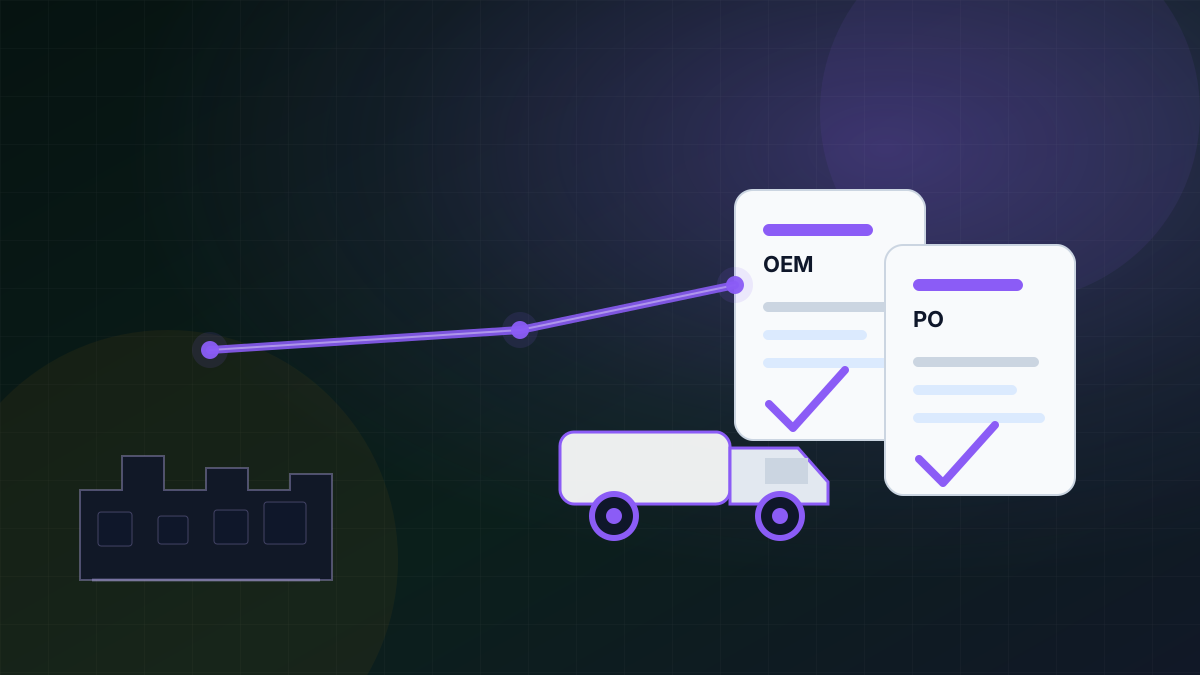
Ontario's Tier 1 and Tier 2 automotive suppliers are no longer being asked whether they care about carbon. They are being asked to fill out product-level carbon questionnaires before they get the next order.
That shift matters. A sustainability report is annual. A customer questionnaire is transactional. It lands inside the same procurement cycle as price, lead time, PPAP status, warranty history, and delivery performance. If a supplier cannot produce a credible number for a stamped bracket, injection-molded component, casting, harness assembly, or machined part, the buyer does not wait for a consultant's PDF. They mark the supplier as a risk.
The new question is not: “Do you have a corporate net-zero target?” The new question is: “What is the kg CO₂e for this part number, for this production lot, using this material mix, at this facility, with evidence attached?”
That is a data infrastructure problem.
The OEM signal is already visible
Ontario's vehicle assembly base includes Toyota Motor Manufacturing Canada in Cambridge and Woodstock, Ford's Oakville Assembly, and Stellantis Windsor Assembly. Around those plants sits a dense supplier network: Magna, Linamar, Martinrea, Multimatic, ATS Automation, and hundreds of smaller metal, plastics, tooling, heat-treatment, and surface-treatment shops.
The OEMs are not asking for carbon data because carbon is fashionable. They are responding to three pressures at once.
First, regulated disclosure is tightening. Canada's CSDS 1 and CSDS 2 are moving climate and sustainability disclosures into mainstream financial reporting. Large customers and lenders will need financed and purchased emissions data, including Scope 3. A supplier's spreadsheet answer becomes an input to someone else's regulated disclosure.
Second, export exposure is rising. CBAM already affects steel, cement, aluminum, fertilizers, hydrogen, and electricity entering the EU. Even suppliers outside CBAM's first product list feel the same procurement discipline: customers want embedded-carbon numbers they can defend.
Third, Bill C-59 changed the legal risk around environmental claims. The Competition Act amendments, including sections 74.01(1.1) and 74.01(1.2), raised the standard for ordinary environmental benefit claims and performance claims. For OEM questionnaires, that means a supplier should not casually claim “low carbon,” “recycled,” “net zero,” or “sustainable” unless the calculation, factor source, boundary, and evidence trail can survive review.
Why automotive questionnaires are harder than they look
The hard part is not the questionnaire itself. It is the data behind it.
A Tier 1 supplier may receive a template from an OEM with 30 fields: material weights, country of origin, processing energy, packaging, transport distance, scrap rate, recycled content, supplier declarations, and confidence score. The supplier then has to answer for hundreds or thousands of part numbers.
For a plastics processor, that means reconciling resin purchases, regrind, sprues, runners, scrap, inventory movement, and production counts by mold, cavity, and shift. For a metal stamper, it means connecting coil receipts, yield, skeletons, scrap bales, and finished-part counts. For a casting supplier, it means alloy chemistry, melt loss, furnace fuel, electricity, sand, coatings, and heat treatment. For a plating shop, it means metal throughput, bath chemistry, drag-out, sludge, wastewater treatment, and electricity.
Most suppliers cannot answer those questions from one system. The data lives in ERP, MTCs, LIMS, weighbridge logs, fuel slips, supplier certificates, SAP, Excel, and email attachments. The result is usually a best-effort estimate with three dangerous words hidden in the comments: “assumptions applied.”
That is exactly what OEM procurement teams are starting to distrust.
The audit question beneath the questionnaire
A credible questionnaire answer has to survive four tests.
Boundary: Is the number cradle-to-gate, gate-to-gate, or including downstream transport? ISO 14067 and the GHG Protocol Product Standard both require the boundary to be explicit. “Part carbon footprint” is not enough.
Activity data: Are the material weights, production counts, scrap rates, and energy use tied to the same period and facility? If a questionnaire uses annual resin spend but monthly production output, the intensity number is distorted.
Emission factors: Are factors sourced and versioned? Natural gas may use Environment and Climate Change Canada factors. Ontario electricity may use IESO location-based data. Steel and resin factors may come from supplier EPDs, industry databases, or fallback life-cycle inventory sources. The choice has to be documented.
Evidence: Can the supplier show where the number came from? A verifier, OEM auditor, bank, or customer procurement team should be able to trace the answer back to source documents, not just to a final workbook.
This is where many suppliers fail. They can produce a number, but not a record.
What the best suppliers will do differently
The winning suppliers will treat OEM carbon questionnaires as part of normal operations, not as a separate sustainability project.
They will map part numbers to material inputs, process routes, scrap streams, and energy meters. They will normalize units across invoices, MTCs, and production logs. They will separate purchased-goods emissions from process emissions, upstream transport, packaging, and waste. They will keep supplier-specific factors where available and document fallback factors where they are not.
They will also stop using one corporate average for every customer. A Magna seat structure, Linamar drivetrain component, Martinrea fluid-handling assembly, and Multimatic chassis module may all be “auto parts,” but they do not have the same carbon profile. A stamped steel bracket and a polymer intake manifold should not share the same intensity logic.
The practical answer is a product-level data model. Every part should carry enough lineage to explain its carbon number: material, mass, process, energy, scrap, factor, source, period, and calculation version.
Where VantageHSG fits
VantageHSG is built for this exact gap. Our data pipeline ingests the raw operational records Ontario manufacturers already generate — MTCs, LIMS assays, fuel slips, SAP logs, batch tickets, weighbridge records, supplier certificates, and utility bills — then normalizes them into a clean carbon data stream.
The Scope 3 engine applies the right calculation logic by product family: material mass balance for plastics and metals, process-specific factors for heat treatment and plating, supplier-specific data where available, and documented fallback factors where necessary. The audit ledger preserves every source document, factor version, calculation step, and user change.
That means an OEM questionnaire becomes an output of the system, not a fire drill.
Ontario suppliers that can answer with evidence will look less risky to OEMs, banks, and verifiers. The rest will keep filling out forms by hand.
Build the carbon data layer before the next questionnaire arrives: /product or /contact.