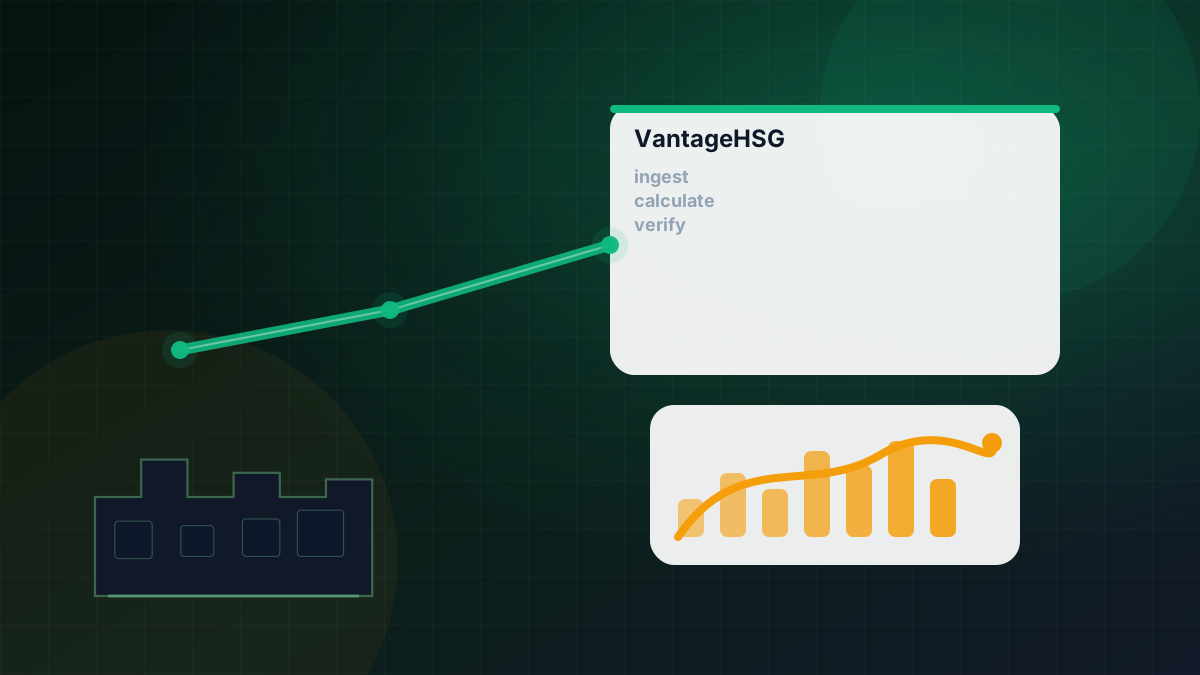
Ontario manufacturers: carbon reporting is no longer a spreadsheet project.
VantageHSG is now positioned as the carbon data infrastructure layer for Ontario heavy industry. It takes the operational documents your plant already produces — mill test certificates, fuel slips, LIMS exports, SAP extracts, supplier files, invoices and utility bills — then turns them into normalized carbon records, Scope 1/2/3 calculations, benchmarks, PDF reports and audit-ready substantiation files.
This is not another ESG dashboard. It is the pipeline behind the numbers.
Watch the product launch video
The launch video walks through the core VantageHSG promise: messy operational data goes in, and defensible Scope 1/2/3 reporting comes out.
What is launching
VantageHSG now gives Ontario manufacturers a single operating system for carbon data:
- Document ingestion: Upload or connect the records your facility already creates: MTCs, fuel slips, LIMS assays, SAP exports, invoices, supplier spreadsheets and utility bills.
- AI extraction and normalization: Pull product, mass, date, supplier, facility, fuel, energy and assay fields into structured records.
- Scope 1, Scope 2 and Scope 3 calculation: Use activity data, mass balance, ECCC/IESO factors, EEIO fallback and supplier-specific data where available.
- Verification and benchmarking: Surface outliers, missing records, supplier gaps and peer comparisons before a regulator, bank, OEM or customer asks for them.
- Audit-ready outputs: Generate PDF reports, methodology notes, source lineage and Bill C-59 substantiation files with factor versions and assumptions attached.
- 15-sector onboarding: Built for Ontario manufacturers across steel, cement, automotive, plastics, chemicals, electroplating and other heavy industrial sectors.
The point is simple: stop rebuilding the same spreadsheet every reporting cycle. Build the data pipeline once.
The problem VantageHSG solves
Most manufacturers do not have a carbon data problem first. They have a data collection problem.
The evidence is scattered across:
- quality teams holding MTCs and LIMS results;
- AP paying fuel invoices;
- operations teams storing SAP exports and production records;
- procurement chasing supplier declarations;
- EHS teams trying to reconcile NPRI, GHGRP, Scope 3, CBAM and Bill C-59 from stale files.
That workflow creates three risks:
- Wrong numbers: Spend-based averages and stale factors can move a carbon number materially.
- No defensibility: A report without source documents, factor versions and assumptions is hard to defend.
- Slow response: Banks, OEMs and EU customers do not wait for your annual spreadsheet ritual.
VantageHSG turns that scattered workflow into a continuous ledger.
How VantageHSG works
1. Bring the documents you already have
Start with the records that prove the real activity:
- MTCs for purchased steel, cement, resins, chemicals and other inputs;
- fuel slips for natural gas, diesel, propane and transport;
- LIMS exports for assays, bath chemistry, scrap and moisture;
- SAP or ERP extracts for purchase orders, material movements and production consumption;
- supplier files, invoices and utility bills.
This is the part most carbon tools skip. VantageHSG starts here because the source record is the proof.
2. Extract the fields that matter
The ingestion pipeline converts messy documents into structured fields:
- supplier;
- facility;
- product or material;
- mass, volume or energy;
- date and reporting period;
- grade, chemistry, moisture or assay values;
- transport mode and distance where available;
- source document ID and uploader.
Every extracted value stays linked to the source document.
3. Route the record into the right calculation
VantageHSG does not force every input through one generic factor. It routes records into the right method based on the data available:
- activity-based calculation where physical data exists;
- mass balance for steel, cement, metals and process-heavy materials;
- ECCC National Inventory Report and IESO Ontario electricity factors where applicable;
- supplier-specific factors when provided;
- EEIO fallback only when primary data is not available.
That gives the team a clear answer: what was calculated from real data, what used a fallback, and what needs follow-up.
4. Keep an immutable ledger
Each calculation records:
- source document;
- extracted fields;
- calculation method;
- factor library and version;
- assumptions;
- gaps flagged for human review;
- timestamp and operator;
- downstream report or export.
This is the substantiation layer that matters for Bill C-59, CBAM, CSDS, NPRI, OSFI B-15 and OEM questionnaires.
5. Turn the ledger into reports
From the same ledger, VantageHSG can produce:
- Scope 1/2/3 reports;
- Bill C-59 methodology statements;
- CBAM-ready embedded emissions views;
- NPRI and GHGRP support;
- OEM questionnaire exports;
- supplier gap lists;
- benchmark comparisons;
- PDF reports for management, auditors and customers.
One data pipeline. Many reporting outcomes.
Who VantageHSG is built for
| Facility type | Main carbon data pain | VantageHSG use case |
|---|---|---|
| Steel and metals | MTCs, scrap chemistry, process emissions, CBAM and OEM product questions | Mass balance, supplier data, embedded emissions and audit trail |
| Cement and concrete | Process emissions, clinker factors, fuel combustion, public NPRI exposure | Activity data, ECCC factors and peer benchmarking |
| Automotive suppliers | OEM questionnaires and product-level Scope 3 requests | Supplier data, lineage and export-ready answers |
| Electroplating and finishing | Bath chemistry, metal releases, NPRI substance thresholds | LIMS extraction, mass balance and threshold monitoring |
| Chemicals, plastics and coatings | Mixed materials, fuel use, supplier declarations and customer audits | Document ingestion, factor lineage and substantiation files |
| Multi-site manufacturers | Inconsistent spreadsheets and stale reporting cycles | Central carbon ledger across facilities |
Pricing and pilot path
The product is designed to start small and prove itself on real documents.
- Starter — $299/month: single-facility Scope 1 and 2 reporting, PDF reports and support.
- Growth — $599/month: full Scope 3, benchmarking, Bill C-59 statement and deeper supplier/data workflows.
- Enterprise — $999/month: unlimited facility coverage, CBAM workflows, ERP integrations and advanced support.
The lowest-friction next step is still the same: send one real source document.
Start with one document
If you are evaluating carbon software, do not start with a demo deck. Start with one document that usually causes pain.
Send one of these:
- an MTC;
- a fuel slip;
- a LIMS export;
- a SAP extract;
- a supplier declaration;
- a utility bill.
VantageHSG will show the extraction, normalization, factor lineage, assumptions and gaps that would need to be closed in a paid pilot.
Send one source document for a sample report
Or compare the paid pilot path:
Why this matters now
Ontario manufacturers are being pulled from three directions at once:
- Bill C-59 makes misleading environmental claims legally risky and pushes teams toward substantiated methodology.
- CBAM Phase 2 makes product-level embedded carbon data a trade issue for exporters and suppliers.
- CSDS and OSFI B-15 are pushing banks and borrowers toward better carbon data.
- OEM questionnaires are moving carbon questions down the supply chain, from steelmakers to Tier 2 and Tier 3 suppliers.
The companies that win will not be the ones with the prettiest ESG report. They will be the ones with the cleanest data pipeline.
FAQ
Is VantageHSG a carbon consultant?
No. VantageHSG is software infrastructure. It ingests the records your team already creates and turns them into repeatable calculations, reports and audit trails.
Can I start before I have perfect data?
Yes. Start with the document that is hardest to reconcile today. The system flags missing fields, assumptions and fallback methods instead of pretending the data is perfect.
Does this replace NPRI, CBAM or Scope 3 reporting?
No. It supports those workflows by creating a cleaner source ledger behind them.
What makes the numbers defensible?
Every output can be traced back to source documents, extracted fields, factor versions, assumptions and calculation methods.
Can my team keep using existing workflows?
Yes. VantageHSG is designed as a headless pipeline behind your current systems. Operations, AP, procurement and EHS can keep using the tools they already use while the data gets centralized.
Next step
If your team is still rebuilding carbon reports from spreadsheets, start with one document.
If you already know the workflow is broken and want to prove it on a facility, start with a paid pilot.
Related reading:
- Why Ontario manufacturers need carbon data infrastructure now
- How to calculate Scope 3 emissions in Ontario
- Ontario NPRI deadline and the spreadsheet trap
- Product overview
- Pricing
VantageHSG provides carbon data infrastructure for Ontario manufacturers. This product launch post was published June 2026 and includes the embedded product launch video.